


Thermal spraying
Many people still use the term flame spraying when referring to thermal spraying. So what is the difference? In practice, very little.
The term flame spraying dates back to the introduction of this surface treatment. Today, thermal spraying is the broader international term, derived from the expression "thermal spray process".
Put simply, thermal spraying is a surface treatment in which a molten layer of metal is sprayed onto a component. It can be used to carry out repairs, such as restoring a worn shaft or bearing seat.
It can also be used to apply a new layer or coating, making the component better suited to the customer's application. This might be a rough coating to provide more grip, or an exceptionally smooth coating to improve lubrication within a machine. The possibilities are almost endless. Thermal spraying is therefore not limited to refurbishment; it can also be used as a preventive treatment for machine components.
The many possibilities
Thermal spraying has an extremely broad range of applications. With the right expertise, the right material can be selected for your application. There are countless options, but one will always be the best choice.
Below you will find the available processes and brief examples to give you a clearer idea of the possibilities.
Consider increasing the hardness of your component. Our thermal-spray coatings can make a component, or a selected area of it, hard enough to significantly reduce wear and extend its service life.
A ceramic coating can be selected to improve insulating performance. Conversely, if you need the component to distribute process heat more effectively, we use thermally conductive coatings such as copper.

Oxy-fuel powder spraying (cold process)
In cold-process oxy-fuel powder spraying, a flame heats a powder feedstock to its melting temperature, accelerates it and sprays it onto a surface to form a coating.
This thermal-spraying method can be used to restore wear on metal components, such as cylinders in hydraulic systems.

Oxy-fuel powder spraying (hot process)
This process is similar to cold-process oxy-fuel powder spraying, but after application the coating is fused at approximately 1,000 °C.
This technique is used where hard coatings resistant to impact, shock, wear and chemical attack are required.

Flame wire spraying
Flame wire spraying uses a flame to melt wire feedstock. The molten material is atomised and sprayed onto the workpiece to create a protective coating.
It is often used to restore worn or damaged surfaces on shafts and gears.

Electric arc wire spraying (ARC)
Electrical energy is used to heat and melt the wire feedstock. The molten material is then sprayed onto the workpiece.
It is used to restore dimensional tolerances on machine components, such as bearing seats.

Plasma spraying
Plasma spraying uses an ionised gas (plasma) to heat and accelerate the spray material, producing a very strong coating with excellent adhesion.
We often use this technique on components exposed to extreme wear, such as turbine blades in aerospace applications.

HVOF Spraying
HVOF (High-Velocity Oxy-Fuel) spraying uses a high-velocity gas stream to accelerate powder particles towards the workpiece, producing a dense coating with excellent adhesion.
It is widely used to restore critical machine components, such as valve seats in internal-combustion engines.

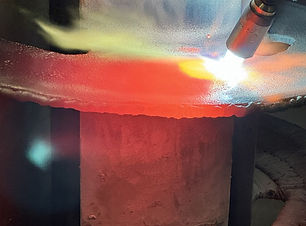
Spray-and-fuse welding (Flipperen)
Powder is fed into a torch, heated to a molten state and then sprayed onto the workpiece; the spray deposit is fused in a single operation. The result is a very dense, strongly bonded and wear-resistant coating. These coatings withstand impact and shock loads.

NEW
Circle Arc is an electric arc wire-spraying process (arc spray) that we developed specifically for applying coatings on site inside cylindrical bores and on the outside diameters of complex components.